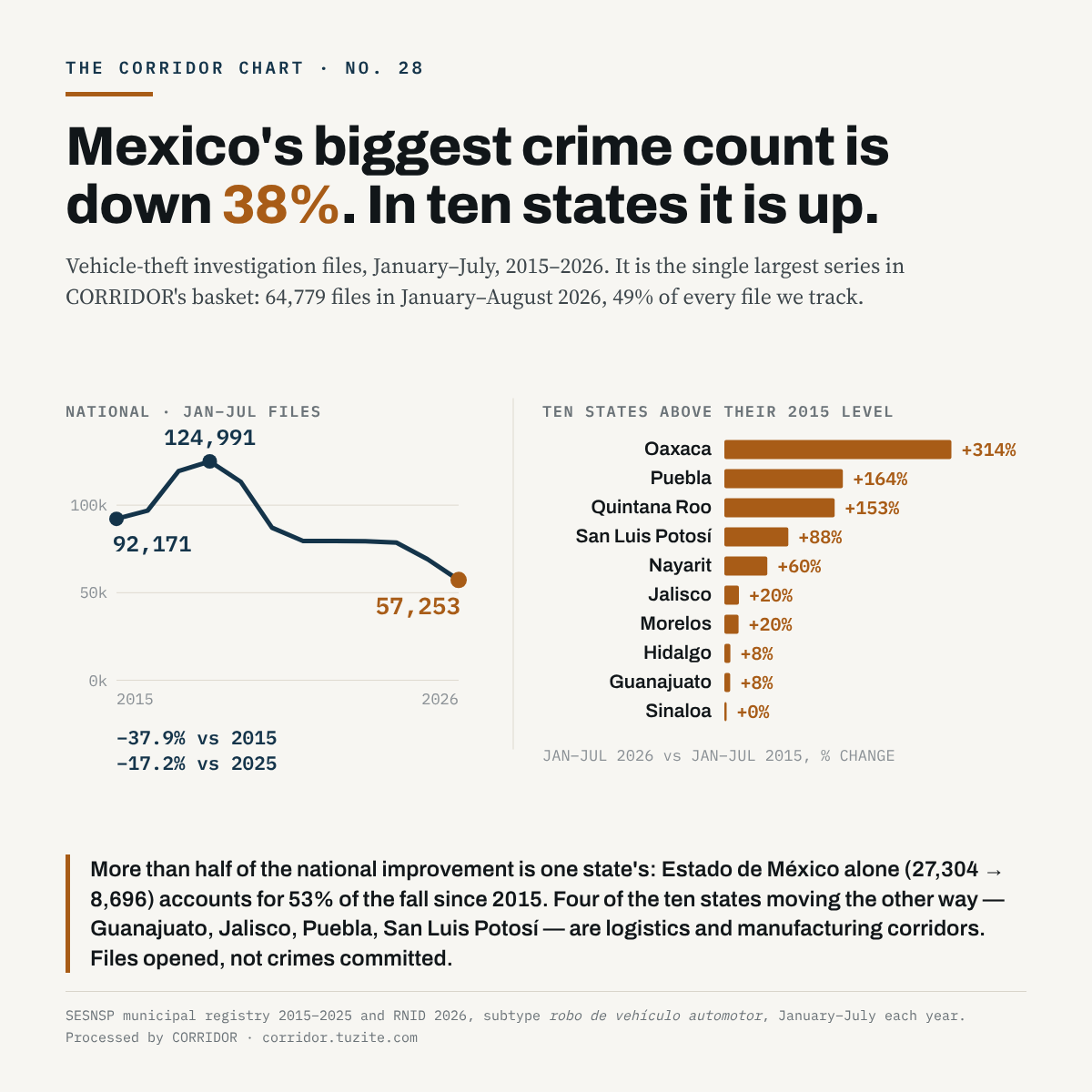
No. 28 · Mexico's biggest crime count is down 38%. In ten states it is up.
Vehicle-theft investigation files, January–July, 2015–2026 — the single largest series in CORRIDOR's basket: 64,779 files in January–August 2026, 49% of every file we track. National January–July files went from 92,171 in 2015 and a peak of 124,991 in 2018 to 57,253 this year: down 37.9% against 2015 and 17.2% against last year. More than half of the national improvement is one state's — Estado de México (27,304 → 8,696) accounts for 53% of the fall since 2015 — and ten states are above where they started, four of them the logistics and manufacturing corridors of the nearshoring story: Guanajuato, Jalisco, Puebla, San Luis Potosí. Until 2025 the registry carried one subtype; the 2026 registry splits it into three — cars, motorcycles, vessels — summed here to rebuild the comparable series. Files opened, not crimes committed. Source: SESNSP municipal registry 2015–2025 and RNID 2026, subtype robo de vehículo automotor, January–July each year. Processed by CORRIDOR.
October 2026
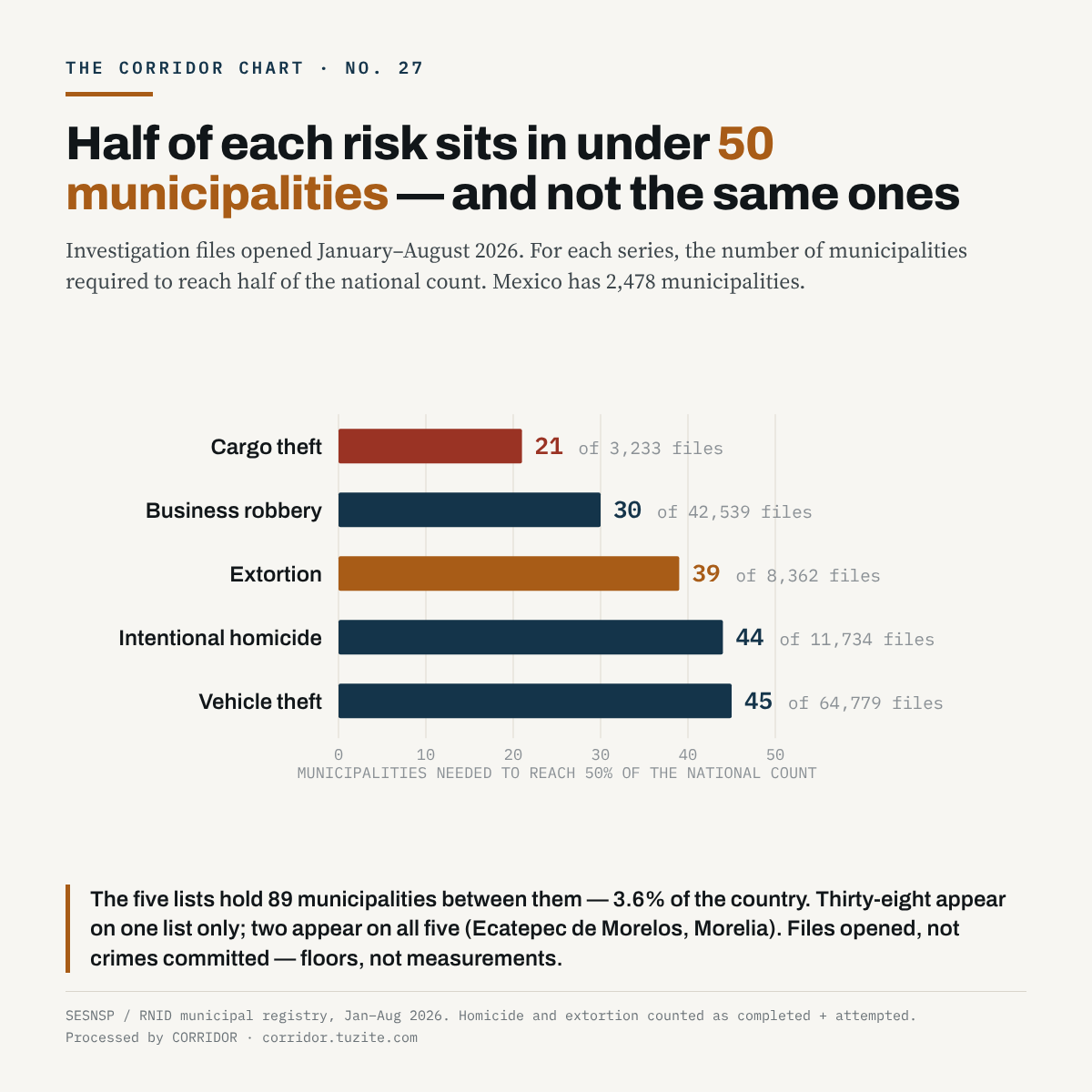
No. 27 · Half of each risk sits in under 50 municipalities — and they are not the same ones
Investigation files opened January–August 2026. The number of municipalities needed to reach half of each national count, out of Mexico's 2,478: cargo theft 21, business robbery 30, extortion 39, intentional homicide 44, vehicle theft 45 — every list under 2% of the country. The five lists hold 89 municipalities between them, 3.6% of Mexico; thirty-eight appear on one list only, and two appear on all five: Ecatepec de Morelos and Morelia. There is no single municipal risk map — there are five, and the one that matters depends on what you are protecting. These are files opened, not crimes committed — floors, not measurements; a low count may mean little crime or little reporting, and the registry does not tell you which. Homicide and extortion counted as completed plus attempted. Source: SESNSP / RNID municipal registry, Jan–Aug 2026. Processed by CORRIDOR.
October 2026
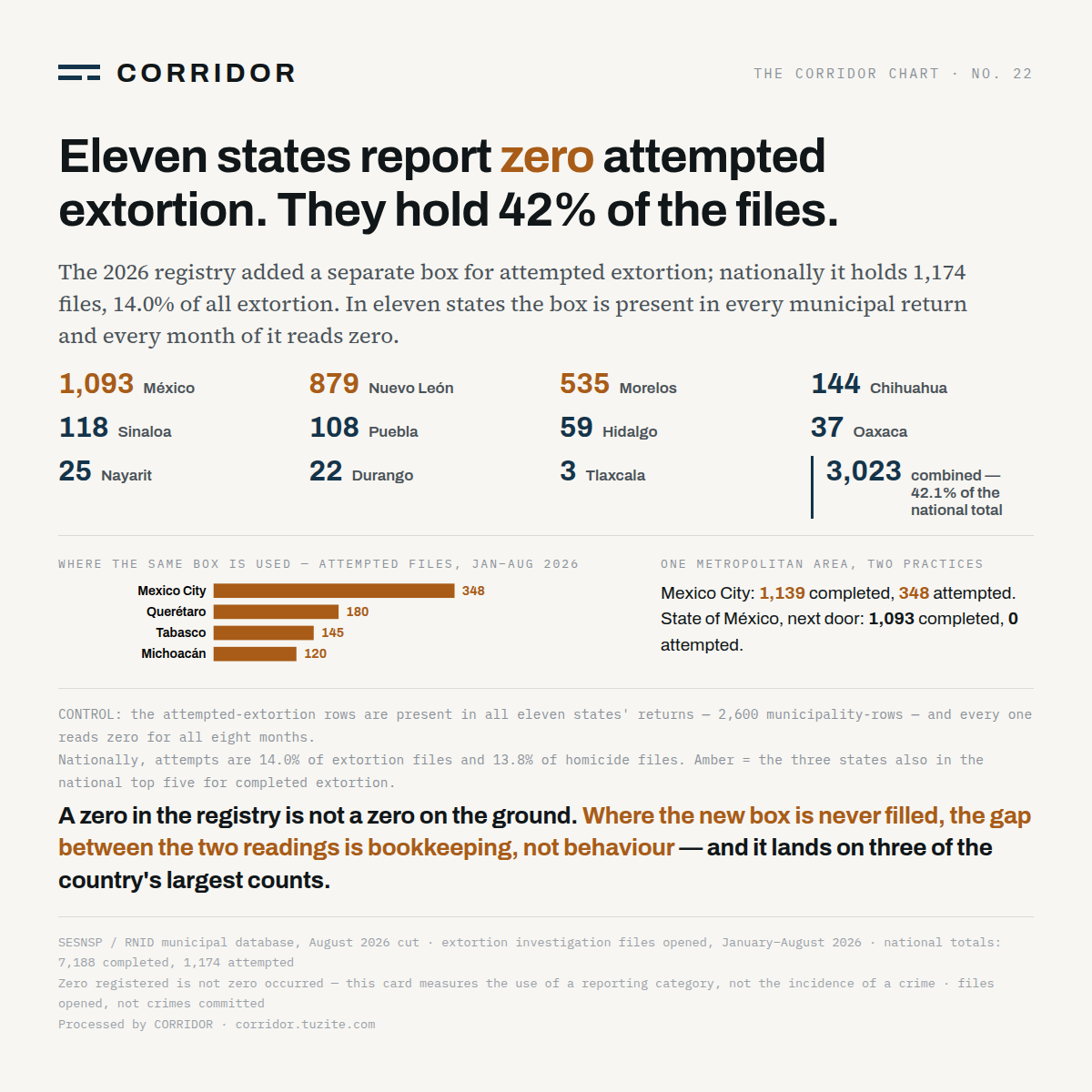
No. 22 · Eleven states report zero attempted extortion. They hold 42% of the files.
The 2026 registry added a separate box for attempted extortion; nationally it holds 1,174 files, 14.0% of all extortion. In eleven states — México, Nuevo León, Morelos, Chihuahua, Sinaloa, Puebla, Hidalgo, Oaxaca, Nayarit, Durango and Tlaxcala — the box is present in every municipal return and every month of it reads zero, while together they hold 3,023 completed files, 42.1% of the national total. Mexico City records 348 attempts; the State of México, next door, records none. A zero in the registry is not a zero on the ground: this card measures the use of a reporting category, not the incidence of a crime. Files opened, not crimes committed. Source: SESNSP / RNID municipal database, August 2026 cut — extortion investigation files opened, January–August 2026. Revision note, Sep 2026 cut: the eleven-state share moved from 42.1% to 41.9% after SESNSP revisions.
September 2026
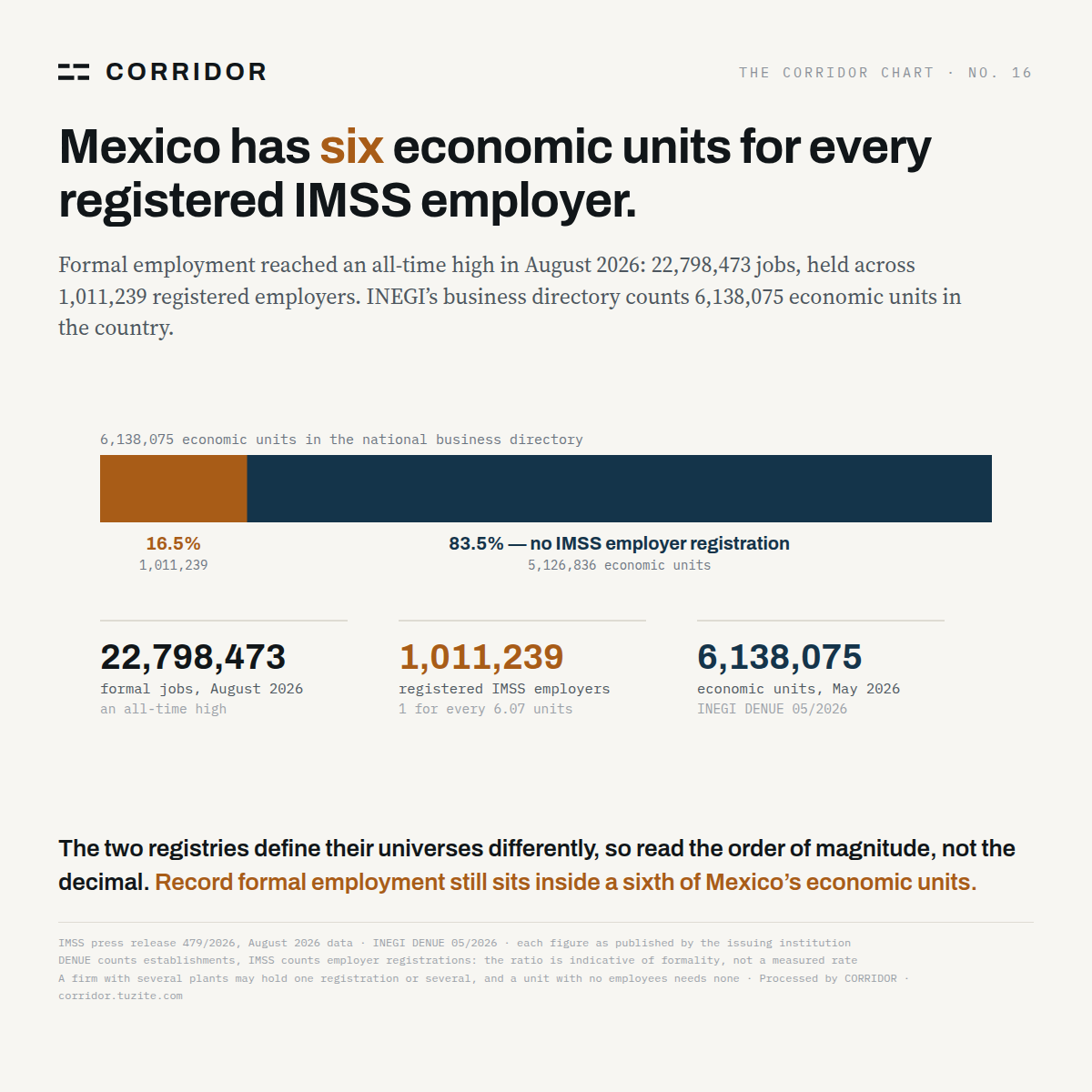
No. 16 · Mexico has six economic units for every registered IMSS employer
Formal employment reached an all-time high in August 2026: 22,798,473 jobs held across 1,011,239 registered IMSS employers, against 6,138,075 economic units in INEGI's national business directory — six units per registered employer. DENUE counts establishments and IMSS counts employer registrations, so the ratio is an order of magnitude, not a measured formality rate. IMSS press release 479/2026, August 2026 data · INEGI DENUE 05/2026.
September 2026
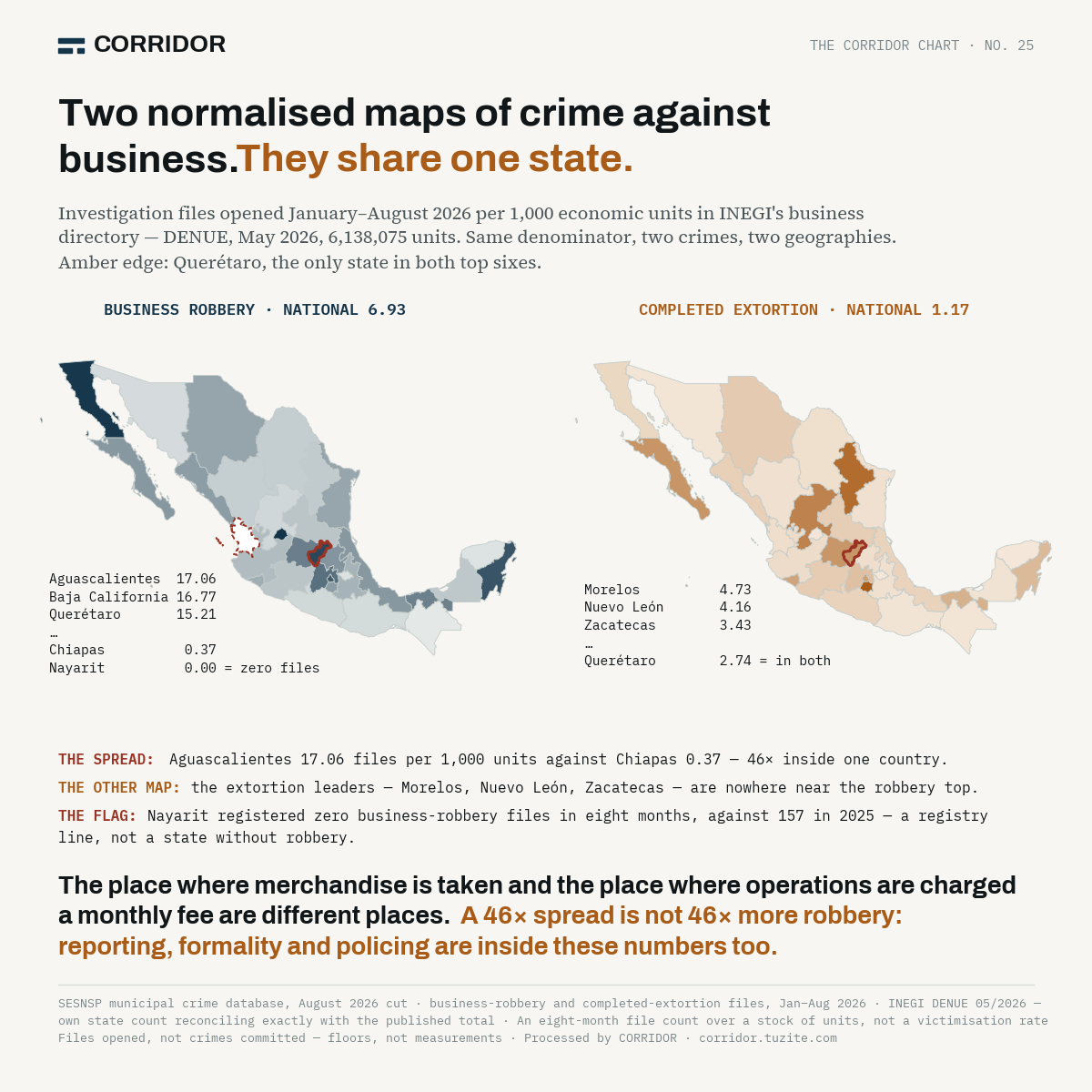
No. 25 · Two normalised maps of crime against business. They share one state.
Business-robbery and completed-extortion investigation files opened January–August 2026, per 1,000 economic units in INEGI's business directory. Aguascalientes leads robbery at 17.06 against Chiapas at 0.37 — a 46× spread; the extortion leaders are Morelos, Nuevo León and Zacatecas, and the two top sixes share only Querétaro. Files opened, not crimes committed — a low rate can mean little crime or little reporting. SESNSP municipal crime database, August 2026 cut · INEGI DENUE 05/2026.
October 2026
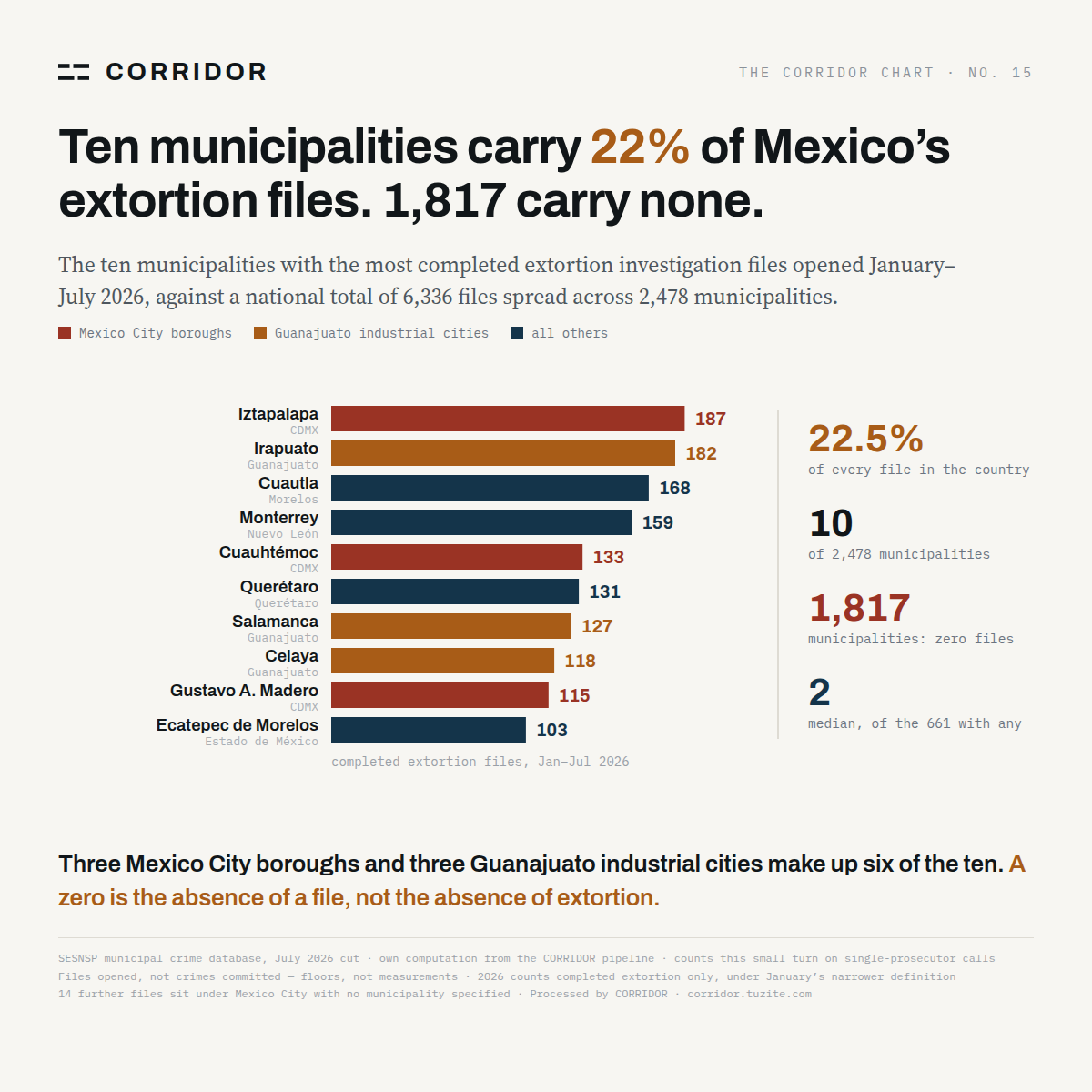
No. 15 · Ten municipalities carry 22% of Mexico's extortion files. 1,817 carry none.
The ten municipalities with the most completed extortion investigation files opened January–July 2026, against a national total of 6,336 files spread across 2,478 municipalities. Three Mexico City boroughs and three Guanajuato industrial cities make up six of the ten. A zero is the absence of a file, not the absence of extortion. SESNSP municipal crime database, July 2026 cut · own computation from the CORRIDOR pipeline.
September 2026
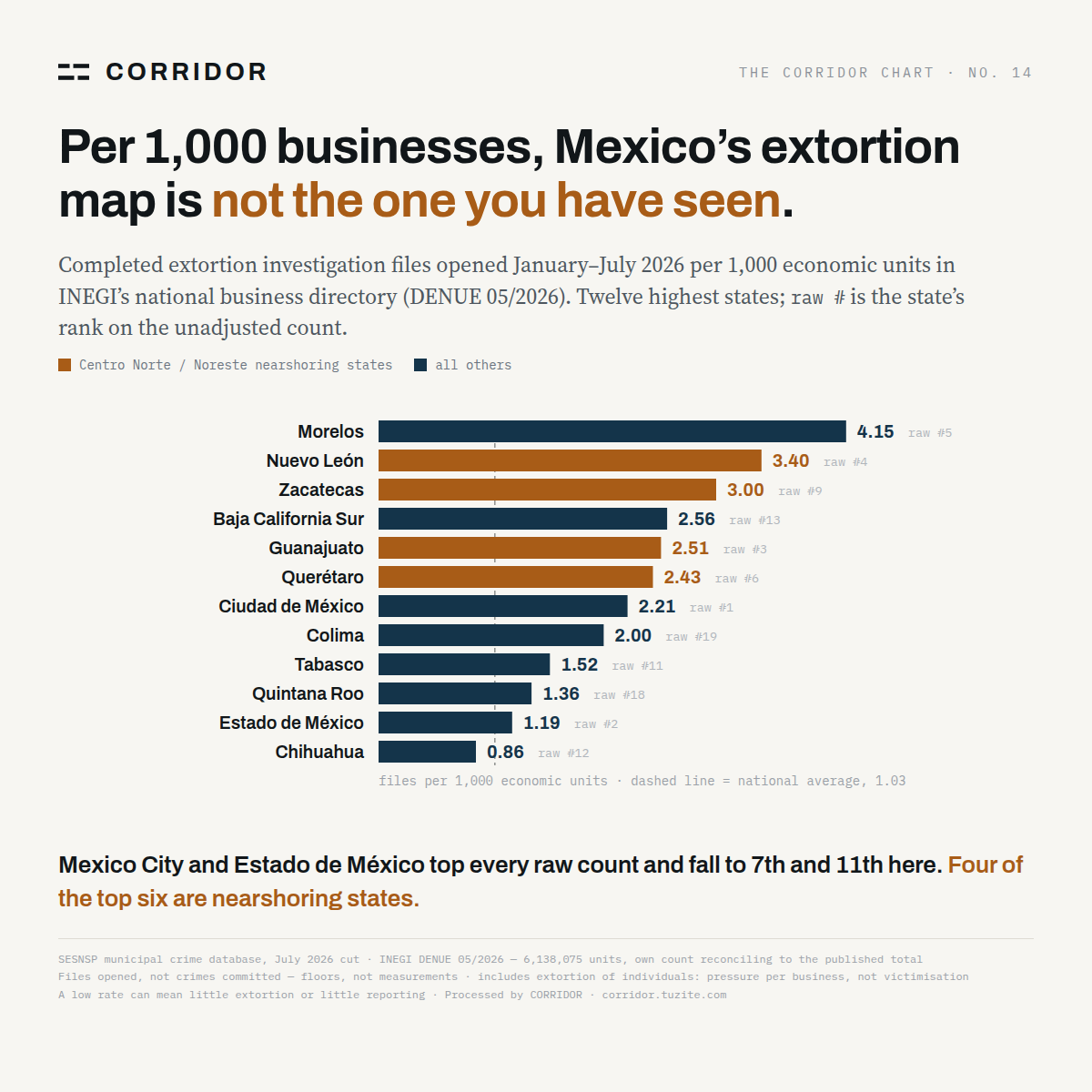
No. 14 · Per 1,000 businesses, Mexico's extortion map is not the one you have seen
Completed extortion investigation files opened January–July 2026 per 1,000 economic units in INEGI's national business directory. Morelos leads at 4.15; Mexico City and Estado de México, first and second on every raw count, fall to 7th and 11th. Four of the top six are nearshoring states. Files opened, not crimes committed — and a low rate can mean little extortion or little reporting. SESNSP municipal crime database, July 2026 cut · INEGI DENUE 05/2026.
September 2026
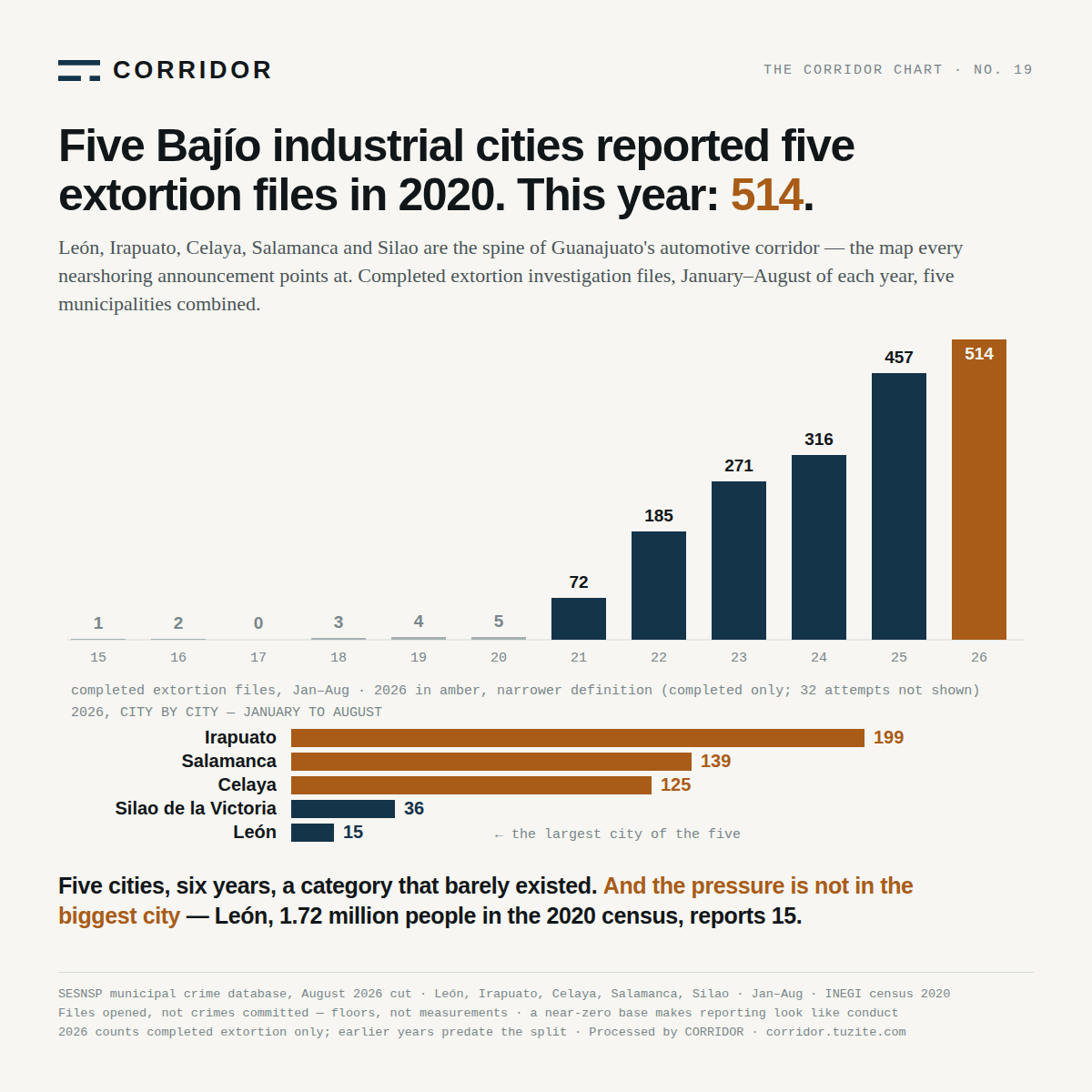
No. 19 · Five Bajío industrial cities reported five extortion files in 2020. This year: 514.
Completed extortion investigation files, January–August of each year, in León, Irapuato, Celaya, Salamanca and Silao combined, 2015–2026. The pressure is not in the biggest city: León, 1.72 million people, reports 15; Irapuato reports 199. Files opened, not crimes committed — floors, not measurements. SESNSP municipal crime database, August 2026 cut · INEGI Census 2020.
September 2026
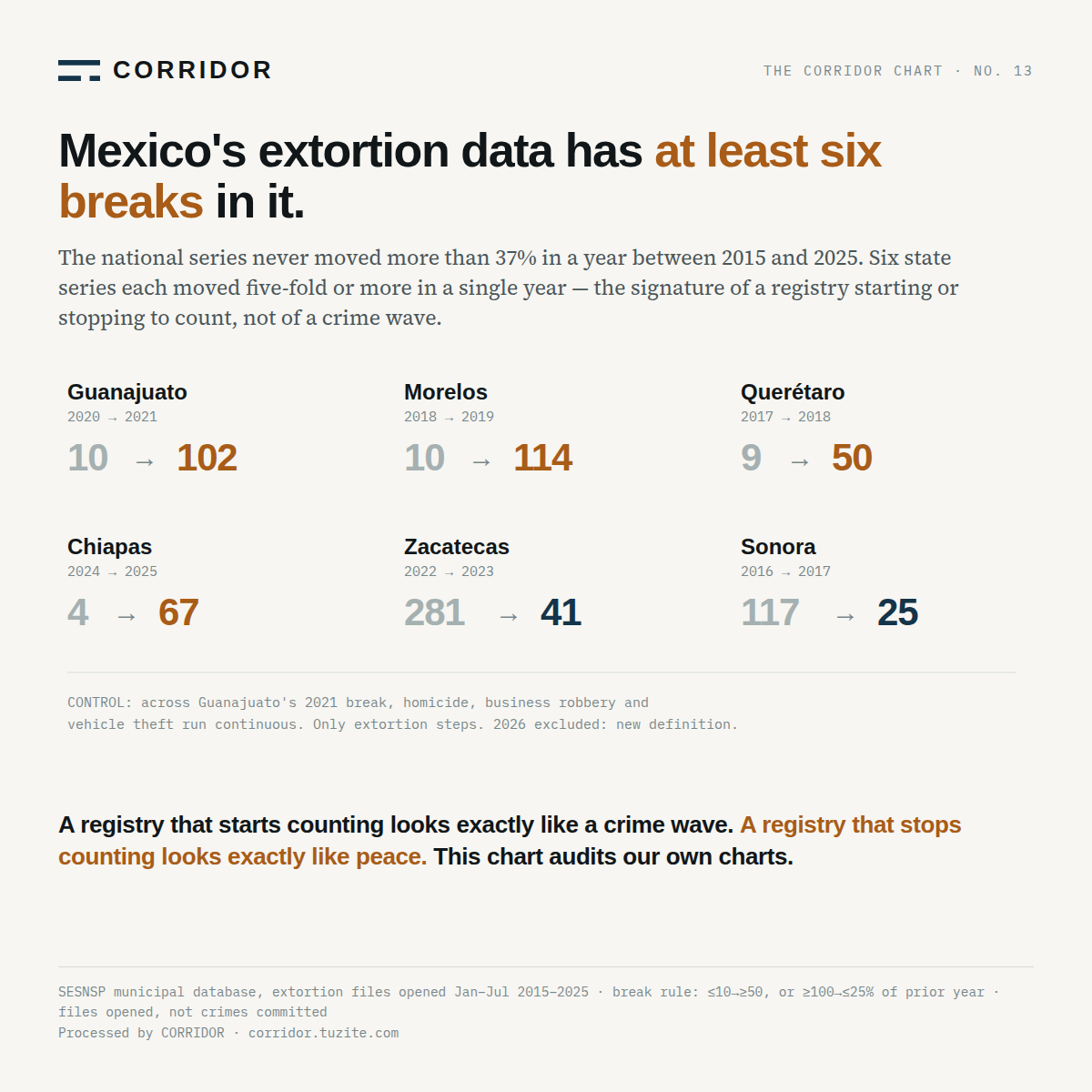
No. 13 · Mexico's extortion data has at least six breaks in it.
The national series never moved more than 37% in a year between 2015 and 2025; six state series each moved five-fold or more in a single year — the signature of a registry starting or stopping to count, not of a crime wave. This chart audits our own charts.
September 2026
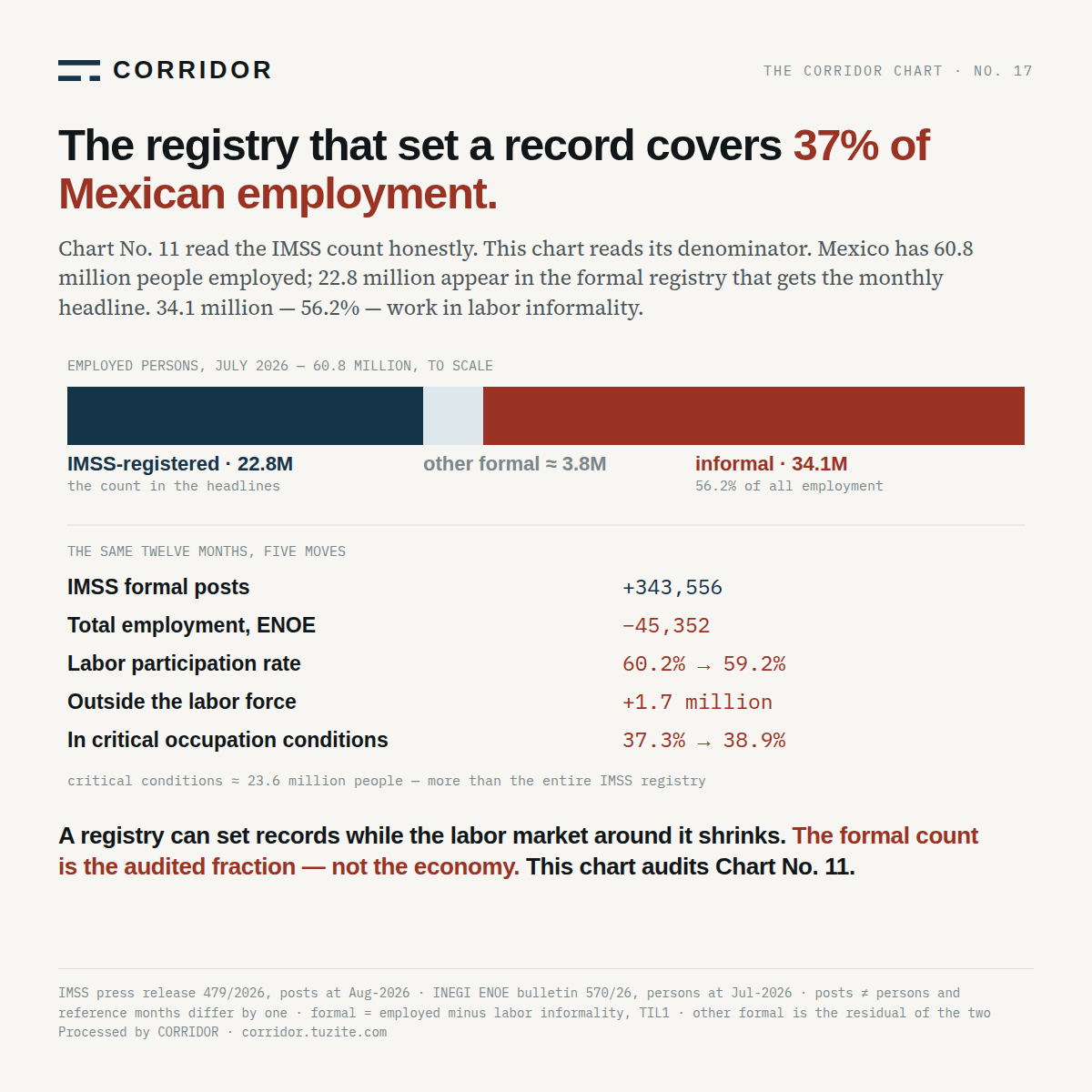
No. 17 · The registry that set a record covers 37% of Mexican employment.
Mexico has 60.8 million people employed; 22.8 million appear in the IMSS registry. Labor informality is 56.2%. In the same twelve months: IMSS posts +343,556, total employment −45,352, participation down one point. This chart audits Chart No. 11.
September 2026
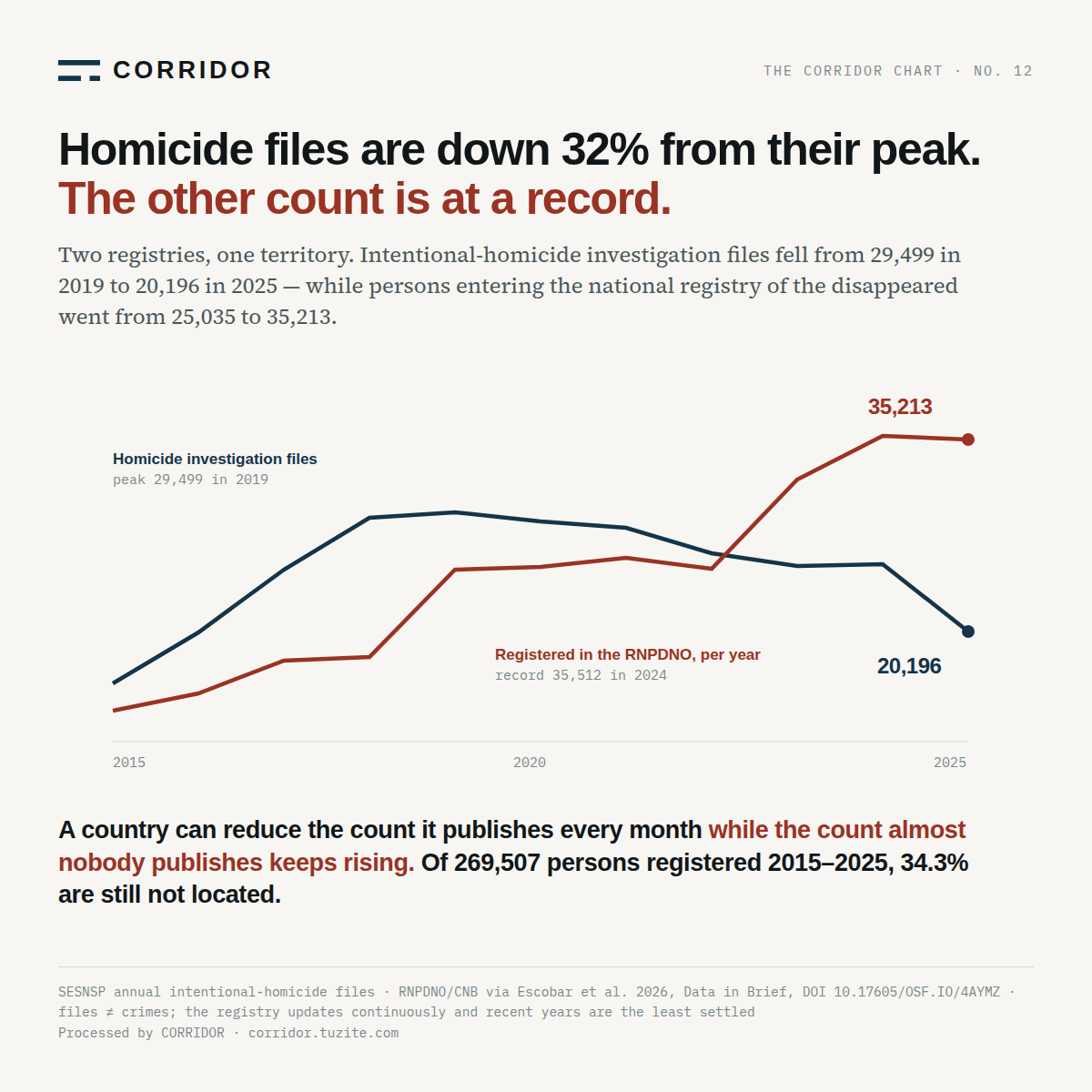
No. 12 · Homicide files are down 32% from their peak. The other count is at a record.
Intentional-homicide files fell from 29,499 in 2019 to 20,196 in 2025 — while persons entering the national registry of the disappeared rose to a record 35,512 in 2024. The two lines crossed in 2023. Of 269,507 registered 2015–2025, 34.3% remain not located.
September 2026
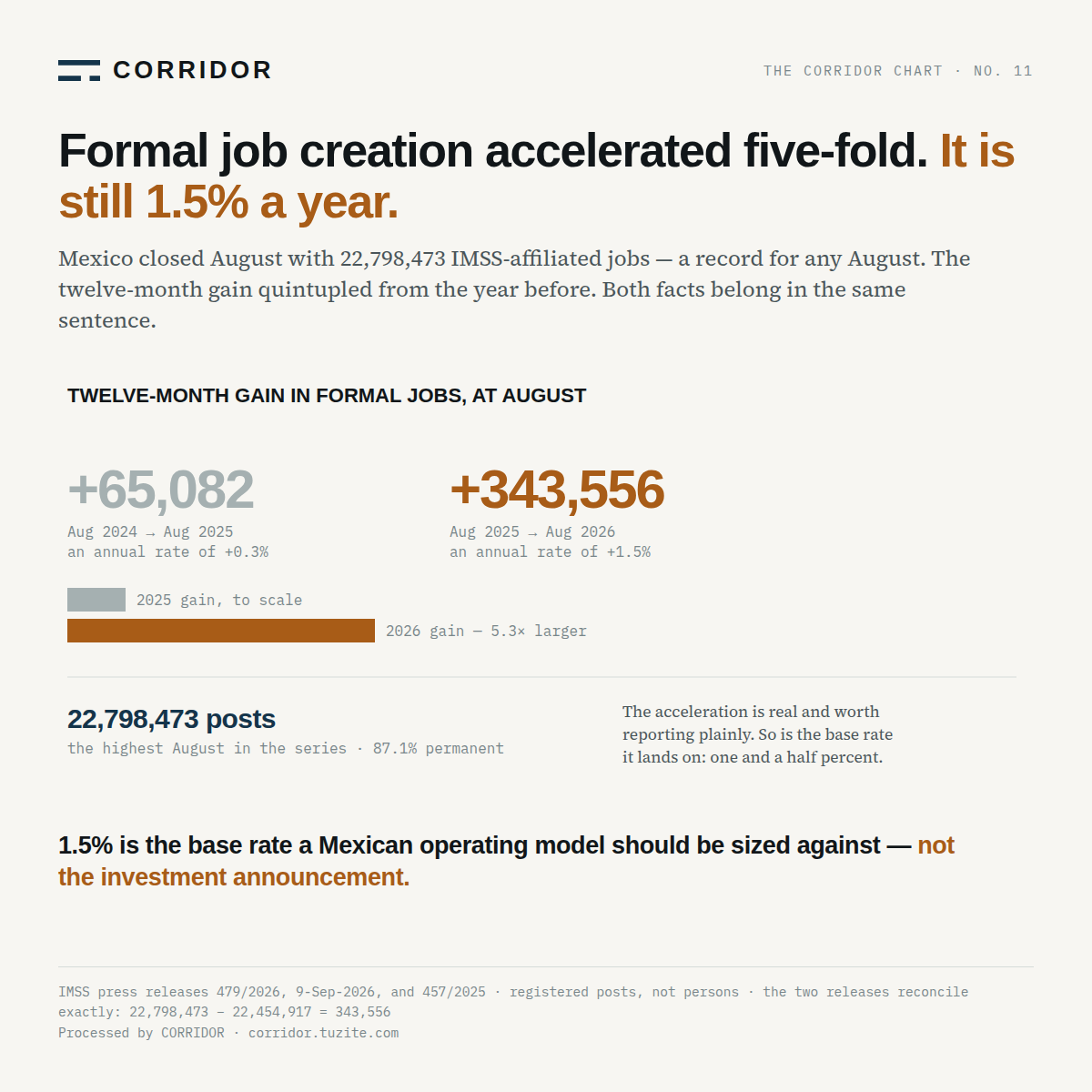
No. 11 · Formal job creation accelerated five-fold. It is still 1.5% a year.
Mexico closed August with 22,798,473 IMSS-affiliated jobs, a record for any August; the twelve-month gain quintupled to +343,556, an annual rate of 1.5%.
September 2026
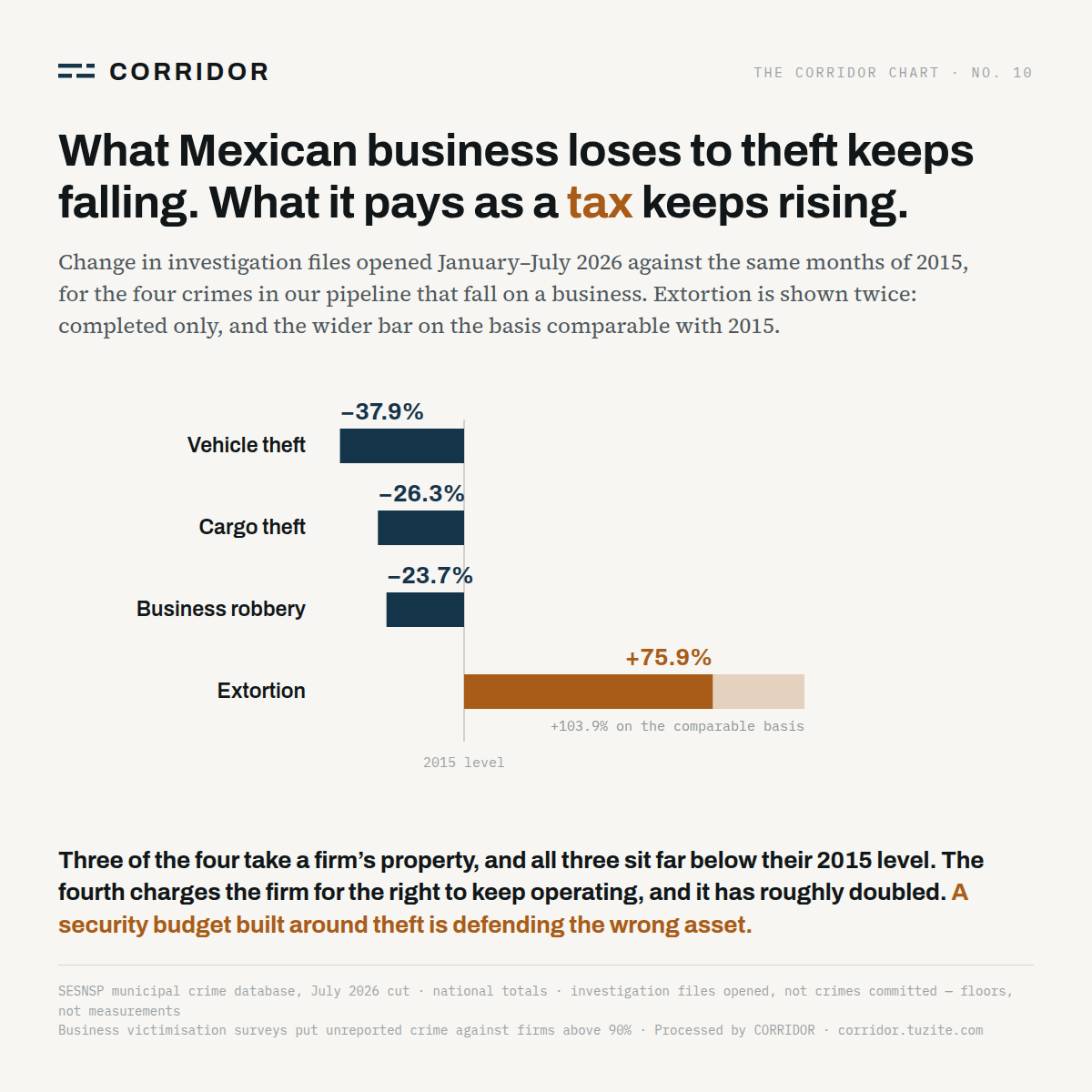
No. 10 · What business loses to theft falls. What it pays as a tax rises.
Vehicle theft −37.9%, cargo theft −26.3%, business robbery −23.7%, extortion +103.9% on the comparable basis — investigation files, Jan–Jul 2026 vs 2015.
September 2026
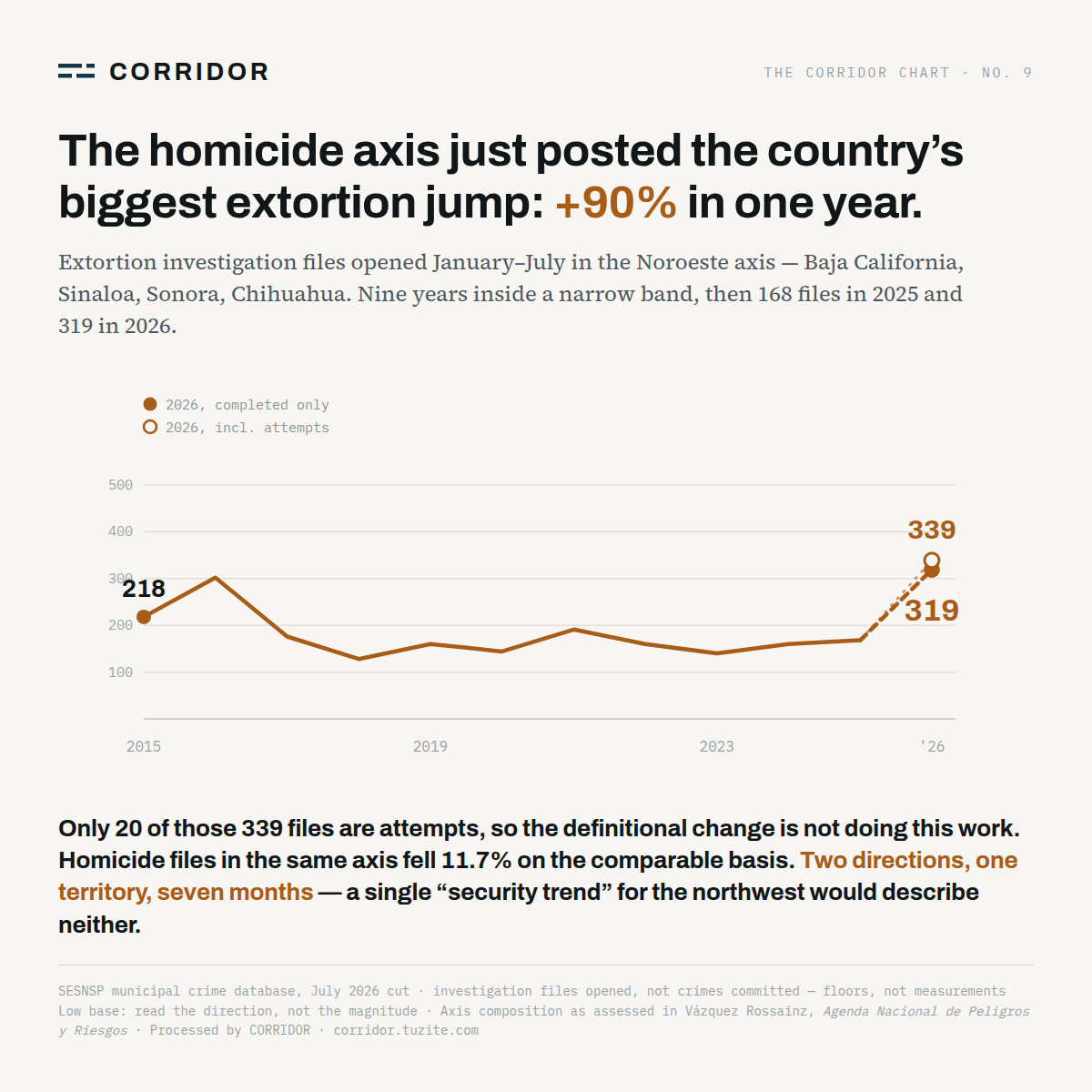
No. 9 · The homicide axis posts the country's biggest extortion jump
Extortion files in Baja California, Sinaloa, Sonora and Chihuahua went 168 → 319 in a year (+90%), while homicide in the same axis fell 11.7% on the comparable basis. Low base — read the direction, not the magnitude.
September 2026
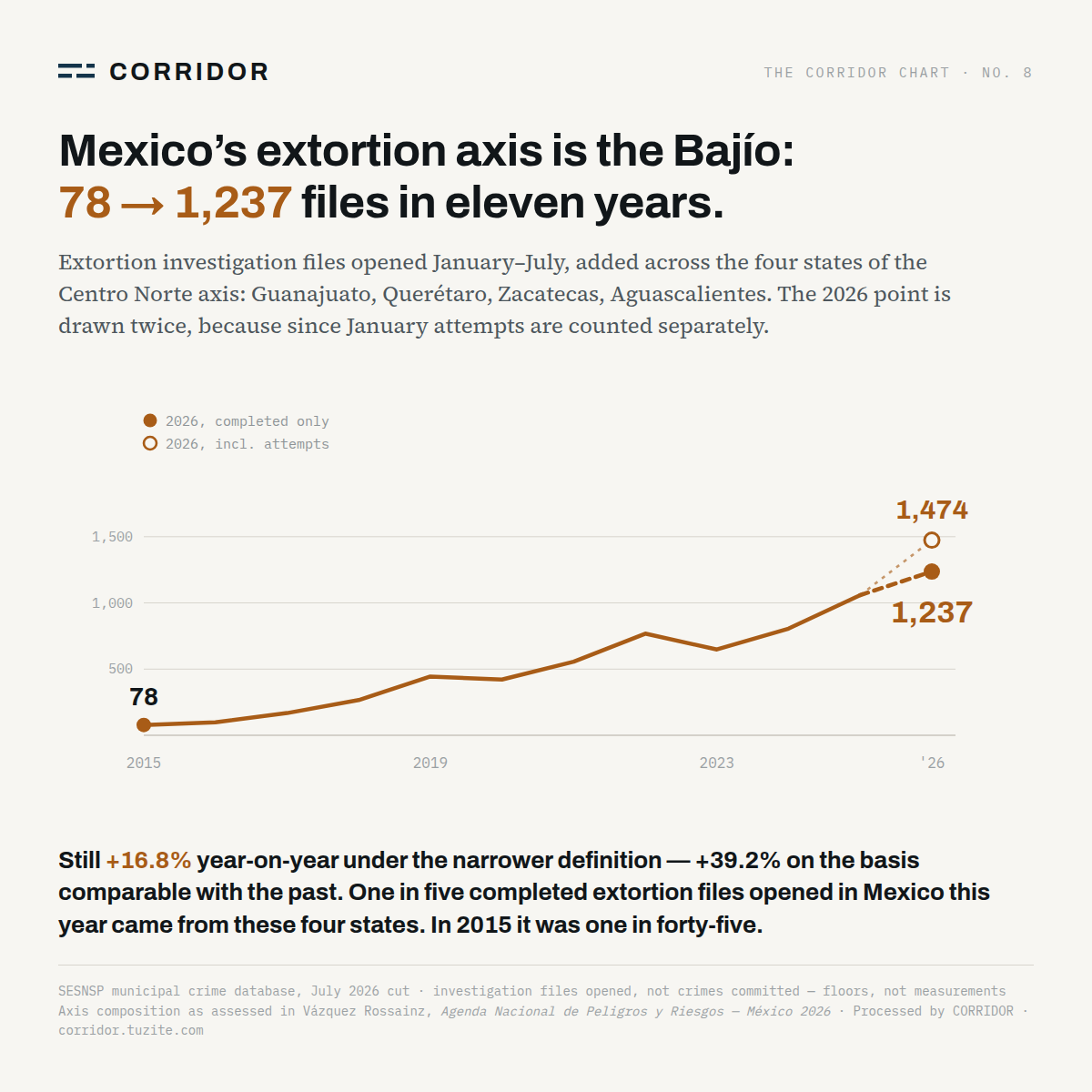
No. 8 · The Bajío extortion axis: 78 → 1,237 files in eleven years
Guanajuato, Querétaro, Zacatecas and Aguascalientes opened 78 extortion files in Jan–Jul 2015 and 1,237 in the same months of 2026. One in five of Mexico's completed extortion files now comes from these four states.
September 2026
Revision note: SESNSP's August cut revised the Jan–Jul Centro Norte figure from 1,237 to 1,239. The chart shows the figure as originally published.
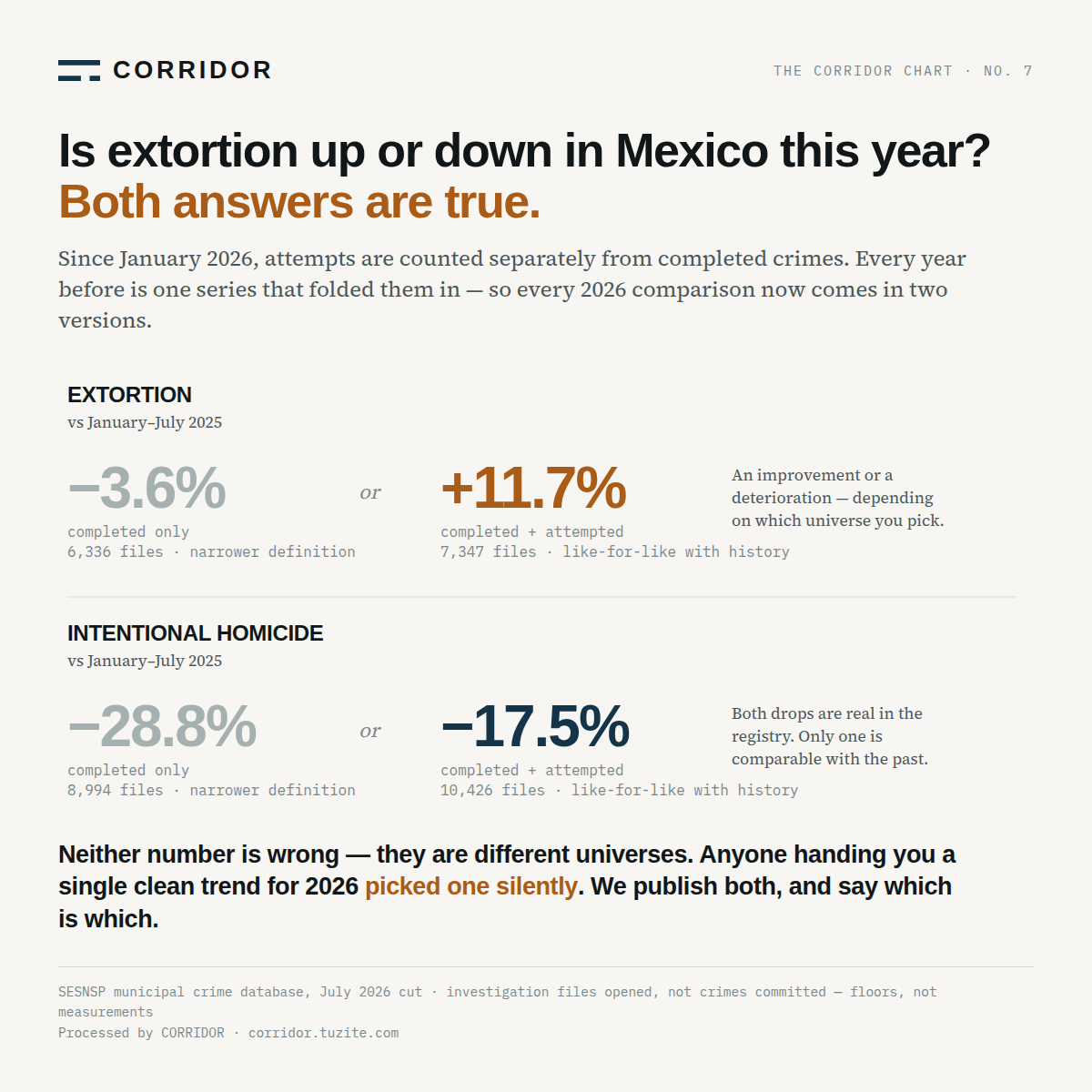
No. 7 · The two universes of 2026
Is extortion up or down this year? Both answers are true — since January, attempts are counted separately, so every 2026 comparison comes in two versions. We publish both.
September 5, 2026
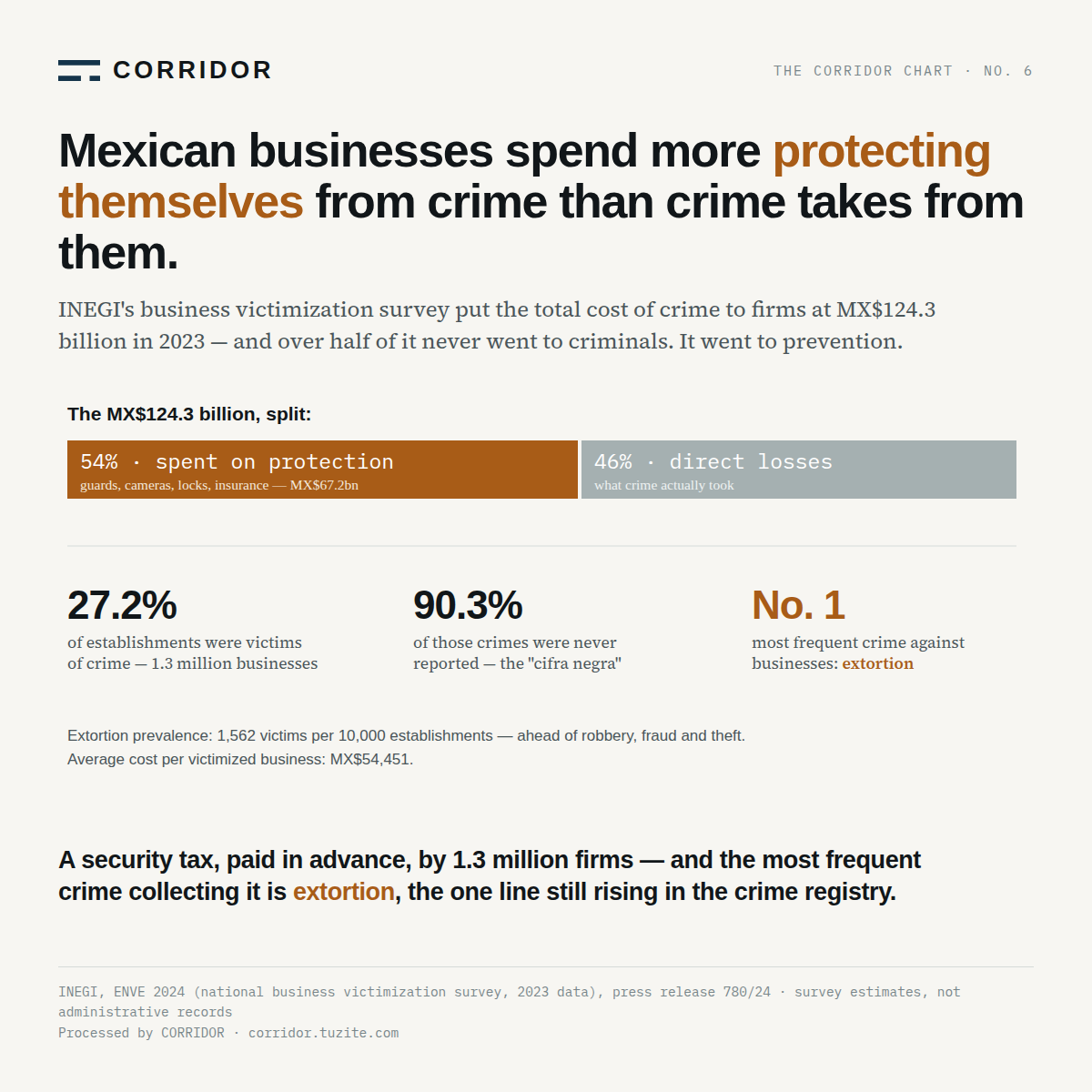
No. 6 · The security tax
Mexican businesses spend more protecting themselves from crime than crime takes from them — 54% of the MX$124.3bn cost of crime to firms went to prevention (INEGI ENVE survey).
September 2026
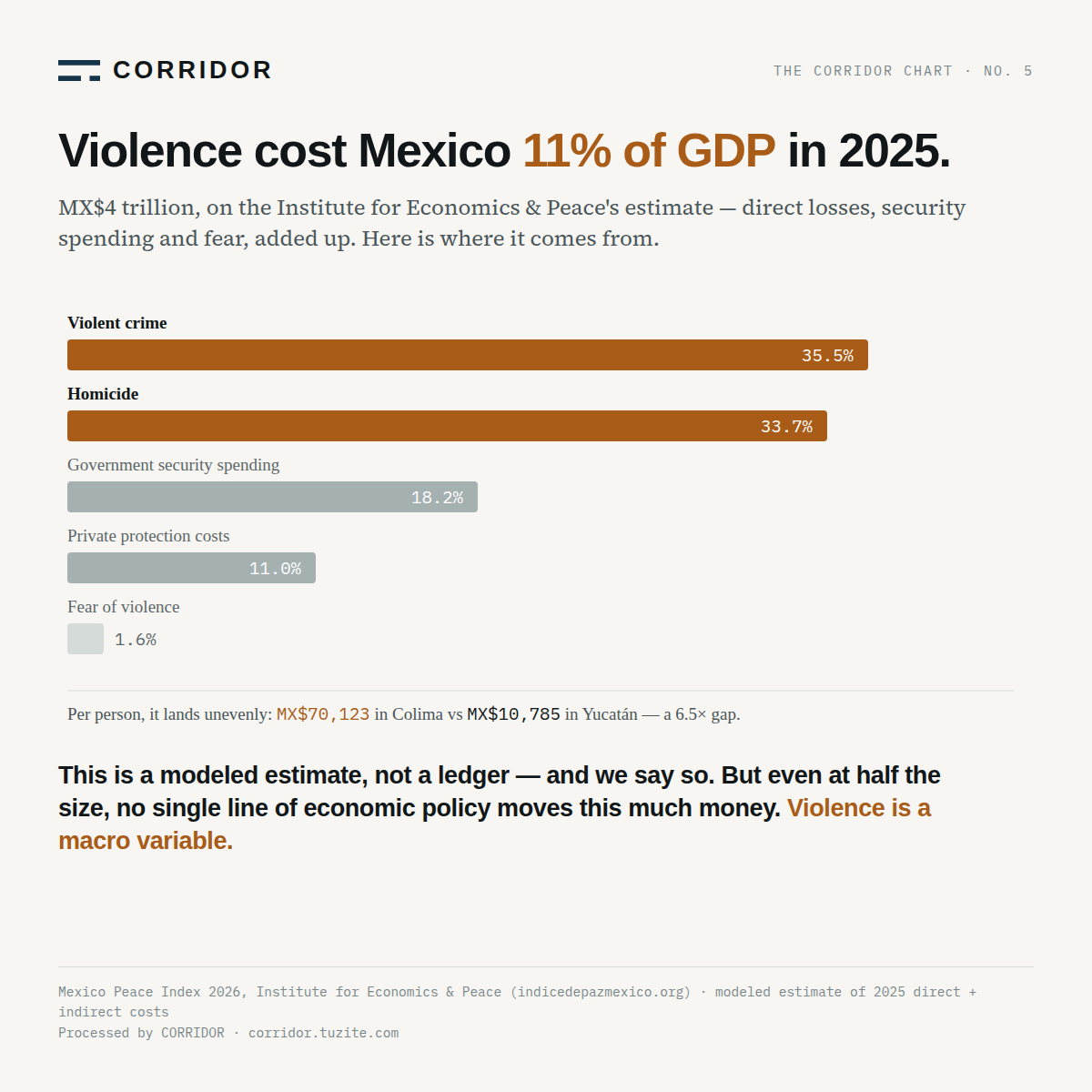
No. 5 · Violence as a macro variable
Violence cost Mexico an estimated 11% of GDP in 2025 — MX$4 trillion on the Mexico Peace Index model. A modeled estimate, not a ledger, and we say so.
September 2026
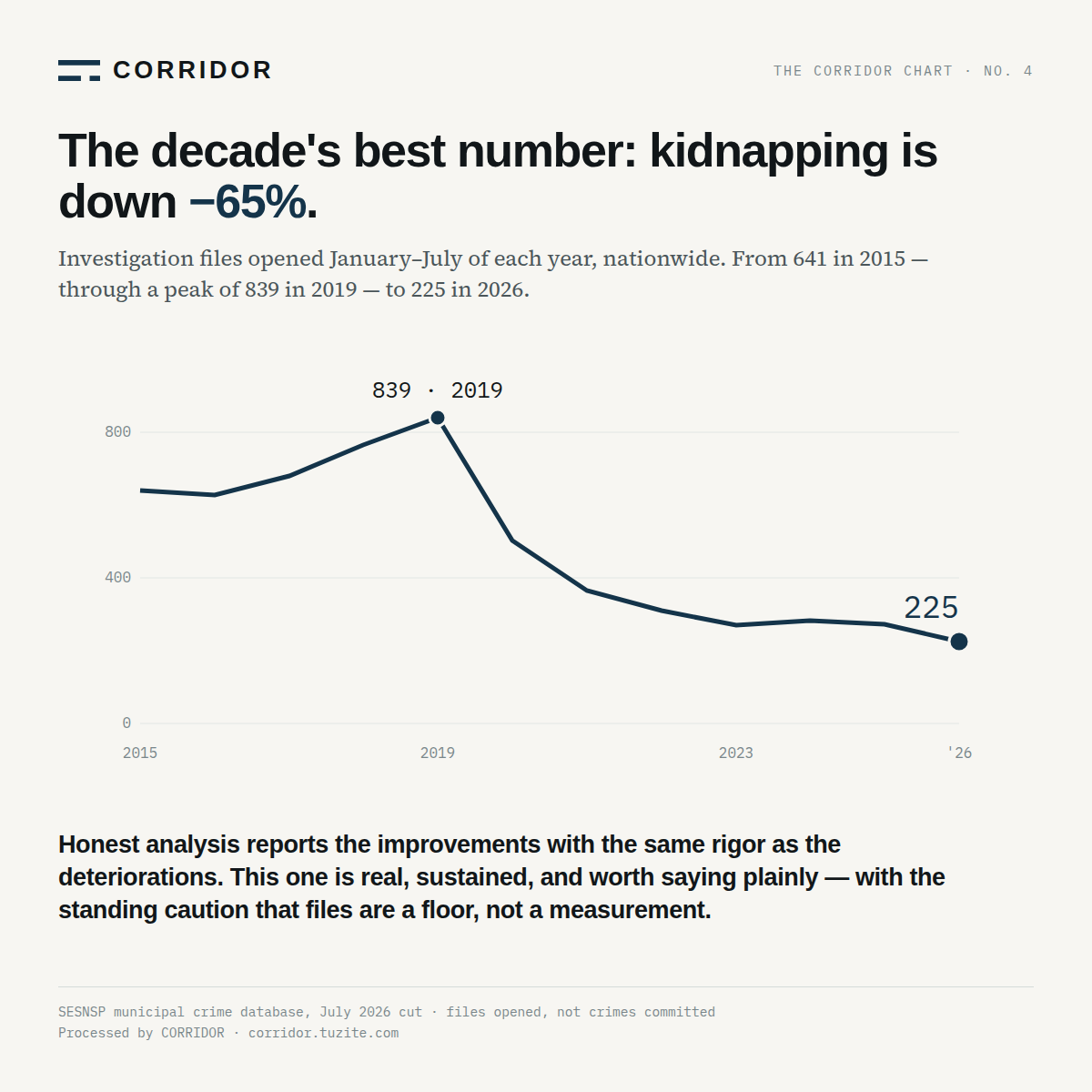
No. 4 · The decade's best number
Kidnapping investigation files down 65% since 2015, falling seven straight years. We report improvements with the same rigor as deteriorations.
September 2026
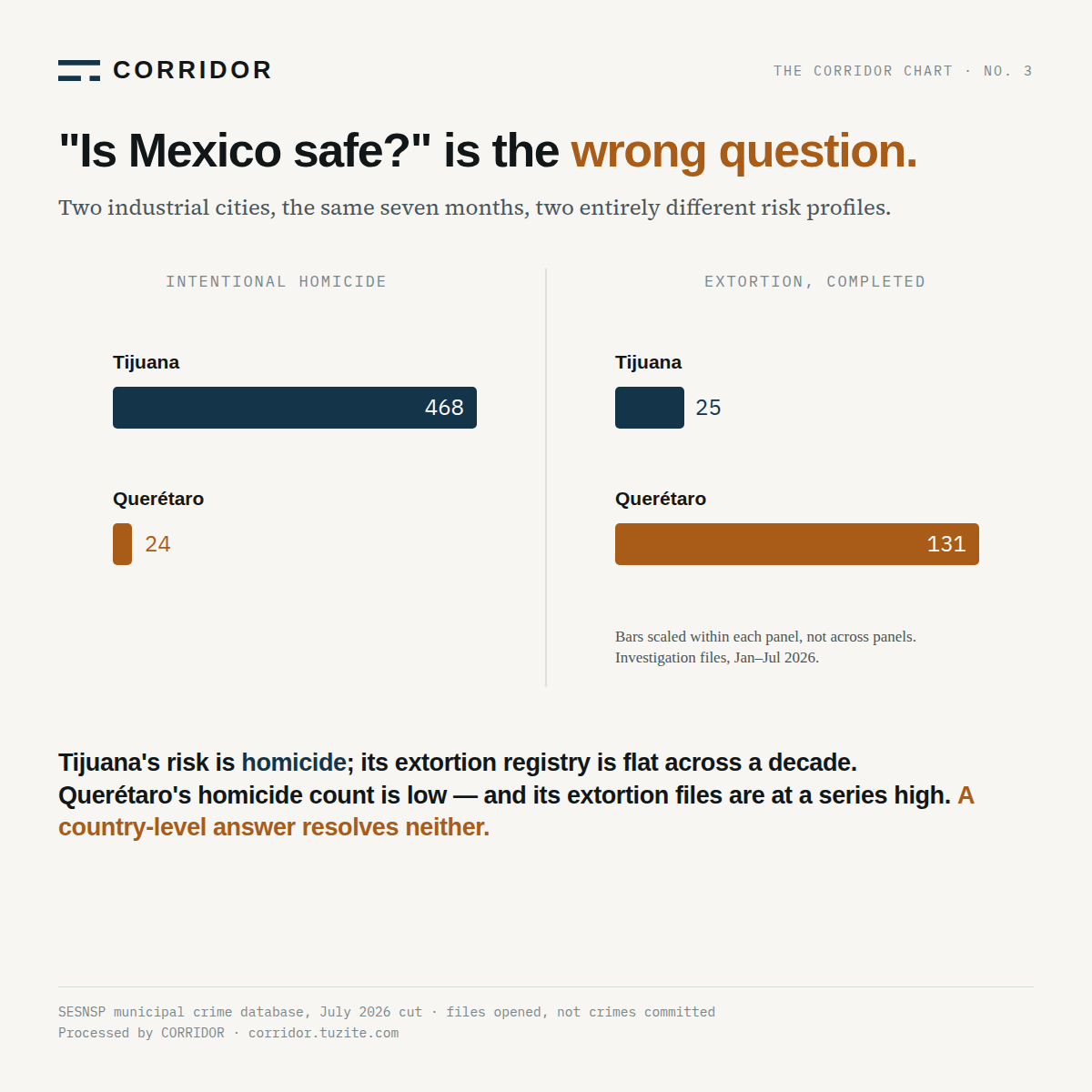
No. 3 · The wrong question
Tijuana: 468 homicide files, 25 extortion. Querétaro: 24 homicide, 131 extortion. Same country, same months, opposite risk profiles — 'is Mexico safe?' resolves nothing.
September 2026
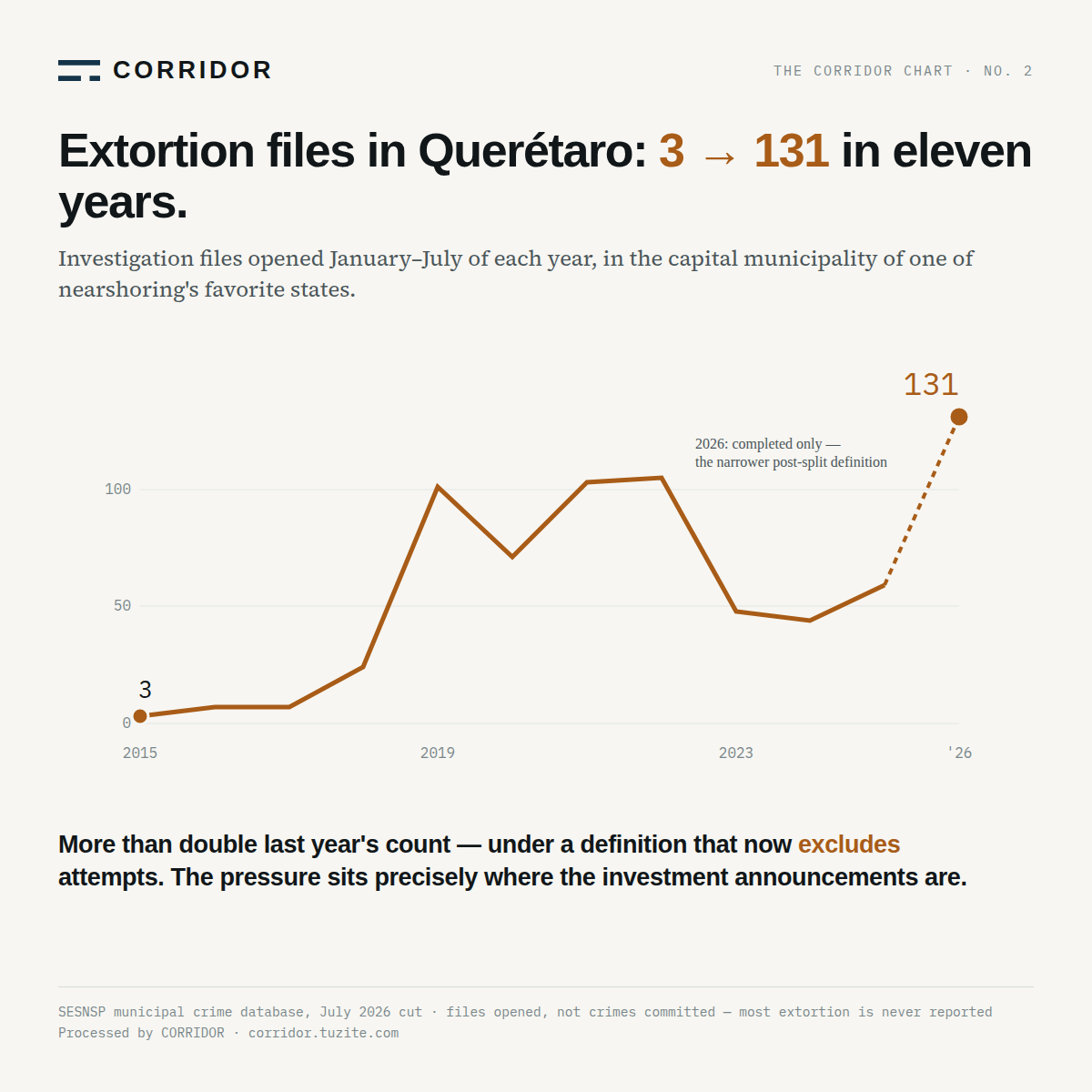
No. 2 · Where the pressure sits
Extortion files in Querétaro: 3 in 2015 to 131 in 2026, January–July — and the 2026 figure excludes attempts. The pressure concentrates exactly where the nearshoring announcements land.
September 2026
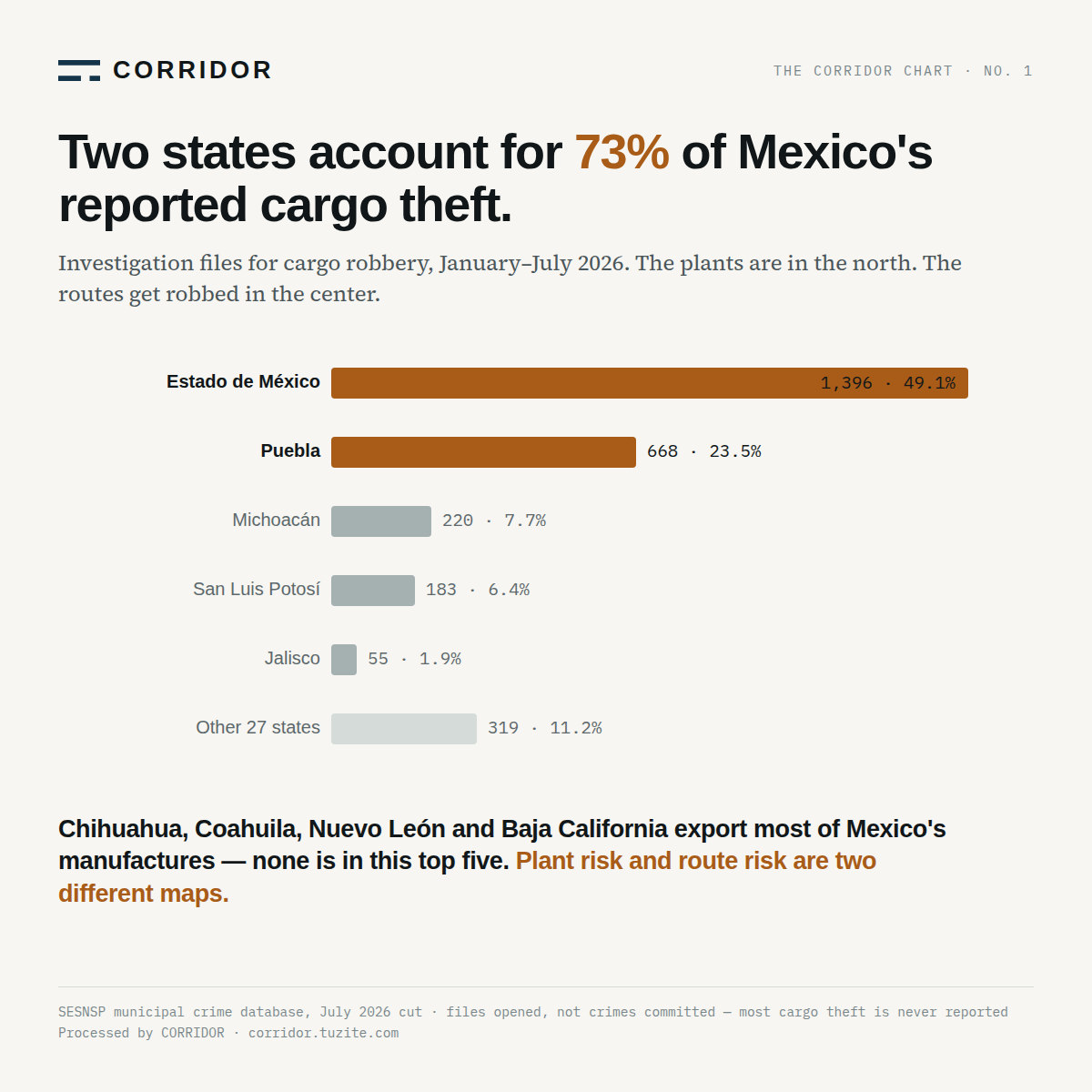
No. 1 · Two maps, not one
Two states account for 73% of Mexico's reported cargo theft — and neither is where the plants are. Plant risk and route risk are two different maps.
September 3, 2026